Tactical Analysis of Pep Guardiola's Systems: How His Philosophy Has Evolved and Why It Works
Few managers in football history have reshaped how the game is understood quite like Pep Guardiola. His teams don't just win — they force opponents, analysts, and rival coaches to rethink their assumptions about space, movement, and control. To follow a Guardiola match without some grounding in his tactical language is to watch a chess game without knowing how the pieces move.
This breakdown covers the structural logic behind his systems at FC Barcelona, Bayern Munich, and Manchester City — and explains the core concepts that any serious football follower should have in their vocabulary.
The Foundations — What Is Guardiola's Core Philosophy?
Juego de Posición — positional play — is the philosophical bedrock of everything Guardiola builds. The principle is simple to state but brutally difficult to execute: control space before controlling the ball, and use player positioning to create numerical and spatial superiority in every zone of the pitch.
Where most tactical systems think in terms of shape and formation, Guardiola thinks in terms of zones. The pitch is divided into corridors and sectors, and the objective is to occupy them in a way that makes the opponent's defensive structure irrelevant. Ball circulation isn't possession for its own sake — it's a tool to shift the opposition's block, open gaps, and create high-probability attacking moments.
Three principles run through every system he has built:
- Compactness without the ball — players collapse into tight defensive structures to deny space centrally
- Positional superiority in possession — the team always seeks to outnumber opponents in the immediate zone of play
- Pressing triggers — coordinated moments to win the ball high, not random individual pressing
These aren't abstract ideas. They show up in every fixture, every set of live scores, and every league table where a Guardiola team has competed.
The Barcelona Blueprint (2008–2012) — Tiki-Taka and the False 9
Guardiola's Barcelona side remains the clearest expression of positional play at its most refined. The system was built around short passing networks, relentless ball circulation, and a spatial concept that suffocated opposition teams before they could organize.
The tactical signature of that era was the false 9 — a role made iconic by Lionel Messi. Instead of a traditional center-forward holding a defensive line deep, the false 9 drops into midfield zones, pulling center-backs out of position and creating space in behind for the inverted wingers to attack. The result was a team with no fixed striker but permanent attacking threat from multiple angles.
What made Barcelona's tiki-taka more than just pretty passing was its spatial logic. Every short combination was designed to draw pressure, then exploit the gap that pressure created. The team functioned as a single pressing unit off the ball — winning possession high up the pitch and converting turnovers into immediate attacks before the opponent could reset.
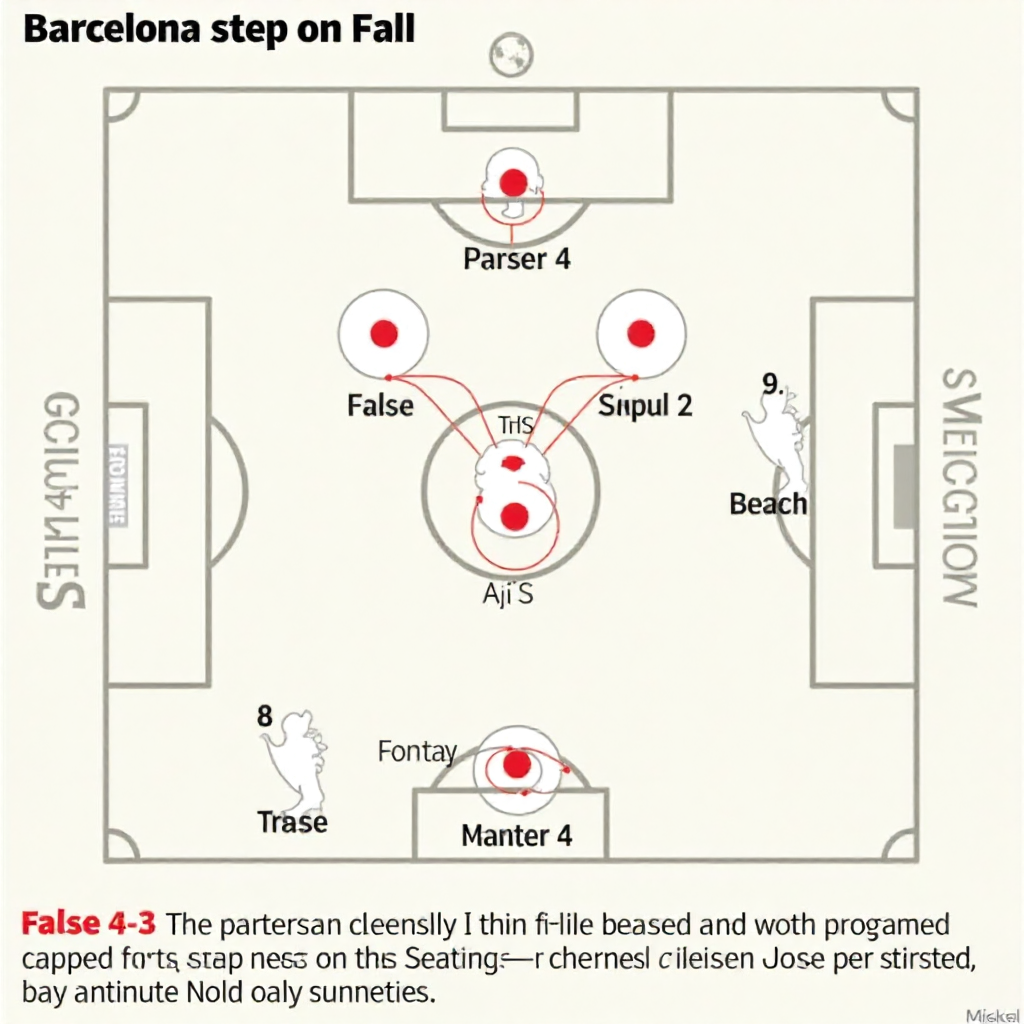
The defensive line sat high, trusting the press to prevent balls played in behind. That trust required extraordinary coordination — and a squad whose technical quality made it possible.
Adapting at Bayern Munich — Adding Verticality and Intensity
At Bayern Munich (2013–2016), Guardiola faced a different problem: a squad built for power and directness, not the intricate combination play of Barcelona. His adaptation revealed something important about his approach — the philosophy stays constant, but the tactical expression changes with the personnel.
Bayern under Guardiola became more vertical. The pressing remained intense, but the transitions were sharper and more direct. With players like Robert Lewandowski and Arjen Robben, holding the ball through 30-pass sequences made less sense than exploiting pace in transition after winning possession high.
The defensive line height was pushed even further up the pitch than at Barcelona, compressing the space the opposition could use and forcing them into a tiny strip of territory. This required the goalkeeper to act as a sweeper — an early version of the sweeper-keeper concept that has since spread across elite football.
Guardiola also experimented more aggressively with positional roles at Bayern, sometimes deploying midfielders as makeshift fullbacks and asking wide forwards to take on central responsibilities. Not all of it worked seamlessly, but the experimentation laid groundwork for what came next.
The Manchester City System — Positional Play at Its Most Complex
Manchester City represents the most sophisticated version of Guardiola's thinking. The system has layers that took years to develop, and it continues to evolve — which is part of why City have remained at the top of the Premier League for the better part of a decade.
The defining structural innovation at City is the use of inverted fullbacks. Rather than overlapping wide to provide crossing options, City's fullbacks tuck inside into central midfield positions during the build-up phase. This creates a midfield overload, allows the team to maintain compactness, and frees the wide forwards to stay high and wide — ready to attack the space left by a disorganized defensive line.
Equally important is City's exploitation of half-spaces — the zones between the opposition's central defenders and fullbacks. These channels are the most dangerous areas of the pitch in modern football, and Guardiola's system is designed to flood them with runners arriving late from midfield or from inverted winger movements cutting inside.
The positional rotations at City can be difficult to track in real time. A player who starts left might drift central while a midfielder covers the flank. What looks chaotic from the stands is actually a structured set of rules — players know their positional responsibilities relative to the ball and to each other, not relative to a fixed spot on the pitch.
Pressing Triggers and Defensive Structure — The Off-Ball Side of Guardiola
Guardiola's teams are often discussed in terms of what they do with the ball. The defensive mechanics are less glamorous but equally deliberate. His sides don't press constantly — they press at specific moments triggered by specific cues.
A pressing trigger is a predetermined signal that tells the whole team to engage simultaneously. Common triggers include a poor first touch by an opponent, a back pass to the goalkeeper, or a lateral pass into a wide defender under pressure. When the trigger fires, the entire team shifts into a coordinated press — not just the nearest player charging forward.
This coordination is what separates organized pressing from chaotic chasing. A single player pressing without support creates space behind them. A whole unit pressing together compresses the opponent's options and forces errors in dangerous zones.
Off the ball, Guardiola's teams maintain a compact defensive block — narrow, short, and difficult to play through. The high defensive line is a calculated risk: it concedes space in behind but eliminates space in front of the defense, where most goals are actually scored. The trade-off only works when the press is functioning properly, which is why breakdowns in press coordination tend to precede the rare occasions when Guardiola's teams look vulnerable.
Key Tactical Concepts Every Football Fan Should Know
Following Guardiola's teams — whether through live scores, match replays, or league analysis — is significantly more rewarding with a basic tactical vocabulary. Here are the terms that appear most often in serious football coverage:
- Juego de Posición: Positional play — structuring the team to control space before controlling the ball
- False 9: A center-forward who drops deep into midfield, disrupting the defensive line and creating space for runners
- Inverted wingers: Wide players who cut inside onto their stronger foot rather than crossing from the byline
- Half-spaces: The zones between central defenders and fullbacks — the most dangerous attacking channels in modern football
- Pressing trigger: A coordinated signal that initiates a collective press rather than individual ball-chasing
- Defensive line height: How high up the pitch the defensive line sits — higher lines compress space but require a functioning press
- Ball circulation: Deliberate passing sequences designed to shift the opposition's defensive block and create gaps
Understanding these concepts doesn't just help with Guardiola — it provides a framework for reading any modern possession-based system in any league.
Why Guardiola's Systems Remain Influential in Modern Football
Guardiola's tactical fingerprints are visible across elite football in ways that go well beyond direct imitation. Coaches who have worked under him — or studied his methods closely — have taken positional play principles into clubs across Europe, South America, and beyond.
The half-space concept, once a niche analytical term, is now standard vocabulary in coaching education. Inverted fullbacks have become a mainstream tactical option at clubs that would never describe themselves as Guardiola disciples. The pressing trigger framework has been adopted and adapted by gegenpressing coaches who sit on the opposite side of the tactical spectrum.
What makes his influence durable is that his ideas solve real problems. Positional play provides a coherent answer to the question of how to control a football match without relying on individual brilliance or physical dominance. That answer scales across different squads, different leagues, and different eras — which is why the tactical conversation around Guardiola is still evolving, not concluding.
For anyone following football seriously — tracking fixtures, reading league analysis, or trying to understand what they're watching in real time — Guardiola's systems offer the clearest window into how modern football thinks about space, structure, and control.
Frequently Asked Questions
What is Juego de Posición and how does Guardiola use it?
Juego de Posición, or positional play, is a tactical philosophy that prioritizes controlling space over controlling the ball. Guardiola uses it by positioning players to create numerical advantages in key zones, forcing opponents into reactive positions before the ball even arrives. Ball circulation is a means to shift the defensive block, not an end in itself.
How does Guardiola set up his team defensively?
Guardiola's teams defend with a high line, a compact block, and coordinated pressing triggers. Rather than sitting deep, they try to win the ball in the opponent's half through organized collective pressing — triggered by specific moments rather than individual impulse. When the press breaks down, the high line can be exposed, which is the primary defensive vulnerability in his system.
What is the role of inverted fullbacks in Guardiola's system?
Inverted fullbacks tuck inside into central midfield positions during build-up play instead of overlapping wide. This creates a midfield overload, keeps the team compact, and allows wide forwards to remain high and wide as attacking threats. It's one of the defining structural innovations of his Manchester City teams.
How has Guardiola's tactics changed over the years?
The core philosophy — positional play, pressing, spatial control — has remained constant. The tactical expression has changed with each club. Barcelona emphasized intricate short combinations and the false 9. Bayern added verticality and a higher defensive line. Manchester City introduced inverted fullbacks, half-space exploitation, and more fluid positional rotations.
Which formation does Pep Guardiola prefer and why does it vary?
Guardiola doesn't think primarily in formations — he thinks in positional structures and zones. A nominal 4-3-3 can become a 3-2-5 in possession and a 4-4-2 out of possession within the same match. Formation numbers are a starting point, not a constraint. The shape shifts based on where the ball is, who has it, and what the opponent's defensive structure looks like.